Monday, December 08, 2008

Taking Off On a Wing and a Prayer


Taking Off On a Wing and a Prayer

GAO Report Blisters Bush on Administrative Debris


OhioNewsBureau

with John Michael Spinelli

Columbus, Ohio: Columbus, Ohio: Coming In On a Wing and a Prayer was a popular patriotic song during World War II that depicted an anxious but jubilant Allied bomber crew limping home from a mission with only one engine working as their airfield came into sight. Migrating the song across time and redirecting it to the flight path confronting President-elect Barack Obama, a new report by the Government Accountability Office (GAO) depicting the deplorable state of the federal government after eight years of George W. Bush shows Obama will be taking off on a wing and a prayer into headwinds of gale force velocity.

The report was issued in response to a request by the ranking member of the Subcommittee on Oversight of Government Management, the Federal Workforce and the District of Columbia,
Committee on Homeland Security and Governmental Affairs of the U.S. Senate, also known as Ohio senior senator George V. Voinovich, for background research that would help elicit views on management challenges within agencies and across government by the political appointees of Obama early next year. Going far beyond what Voinovich thought he would receive, the report turned out far more extensive and painfully embarrassing and frightening for both Voinovich, who may run in 2010 for a third term, and his party's lame duck president, George W. Bush.

In a letter signed by Gene L. Dodaro, Acting Comptroller General of the United States, Voinovich was told that "The incoming administration will face challenges in implementing its policy and program agendas because of shortcomings in agencies’ management capabilities."

An expose by Jonathan Stein writing in Mother Jones Magazine of the 155-page report, shows why Obama will need more wings, engines and prayers if he's to get aloft and above the troubled storm clouds of bad management that are swirling as we speak.

The report is divided by department and is limited to "basic management capabilities," in that it raises questions about personnel, resource distribution, IT, and "results-oriented decision making."

Stein says the politicization of the Justice Department, a situation that arose and forced US Attorney General Alberto Gonzales from office, is not mentioned. Straight foreword and non-partisan as it it, the scope and depth of the report is a clear window into the labyrinth of internal problems of the Bush Administration that show Obama the extent to which Obama is flying into a storm packed with mismanagement, inefficiency, and faulty communication practices.

For example, Stein notes that The Department of Homeland Security and Department of Agriculture have no plan to work together in the event of a food-borne disease outbreak or terrorist attack. The Department of Defense's security clearance process takes so long, the GAO says, that it jeopardizes classified information. The report observes that the Environmental Protection Agency's chemical risk assessment program is improperly influenced by private industry.

Given President Bush's repeated reliance on lobbyists and others from the private sector, who often had no skill set or experience that matched up with the requirements of certain positions of power, it's little wonder that the Chicago community organizer is willing to anger far left stalwarts of the Democratic Party by appointing experienced Washingtonians, regardless of whether they served with former President Bill Clinton.

In a timely post that addresses the importance of the report, Obama's deputy campaign manager Steve Hildebrand, writing in the Huffington Post, advised the battle-hardened members of his party's progressive, activist branch to understand the mine field that lay ahead, and to cut their nominee, now president-elect, some slack for picking the cadre of appointees he has, who have largely won plaudits from Republicans and independents alike.
"Now comes the hard part - assuming the presidency at a time when there are more major problems facing our country and the world than at the beginning of any administration. Our economy is in shambles, affecting people at every income level. Nearly 500,000 jobs were lost during November alone. Retirement and investment accounts were shattered as the Stock Market dropped by historic proportions. Record numbers of families are being forced from their homes. Banks are hardly making loans to anyone right now. Auto manufactures and auto dealers have seen their sales drop between 30 and 40 percent.

"We have a war with Iraq that needs an exit strategy and attention by our new president and his foreign policy team. There is unrest with Iran, Pakistan, North Korea and a host of other countries. We desperately need to repair our Nation's reputation around the world. And we need to do all we can to protect our soldiers overseas and our people here at home.

"Nearly fifty million Americans have no health insurance, left vulnerable and one catastrophe away from bankruptcy or worse yet, death. This number will increase if we see unemployment continue to grow." [Steve Hildebrand, HuffPost]

Now that the election is over, we can look back on the contentious and silly debate pitting judgement against experience. Obama ran with judgement -- especially on Bush going to war with Iraq -- while his primary rival, New York Sen. Hillary Clinton, now his nominee for Secretary of State, chose experience as her jousting lance.

We can only count our lucky stars that the duo of so-called mavericks of John McCain and his running mate Alaska Gov. Sarah Palin -- who just wanted to be elected they could "shake up Washington" but whose judgement and experience were her downfall -- were not elected, given the daunting challenge the results of the report represent.

John Michael Spinelli is a former Ohio Statehouse government and political reporter and business columnist. To send a tip of comment, email ohionewsbureau@gmail.com


Saturday, December 06, 2008

Ho Ho Ho Help


Ho Ho Ho Help

Detroit Big Three, UAW Prepare for Bad Tidings


OhioNewsBureau

with John Michael Spinelli

Columbus, Ohio: Detroit's Big Three automakers and the United Auto Workers union may wake up Christmas morning to find nothing under their tree, if congressional Republicans and their lame duck president stand tough and not throw good money after bad by letting General Motors, Ford and Chrysler fall into bankruptcy, a scenario expert witnesses who also testified Friday said was not in the best interest of the nation.

The leaders of the Big Three car-makers, who this week drove to Washington in their most fuel efficient vehicles instead of flying there by fossil-fueled corporate jets as they did last week, did double duty by repeating their talking points, with hat in hand and a big tin cup, to the Senate and House. The three car stewards from Detroit asked lawmakers for about $34 billion. This amount, nine billion more than the troika said they needed last week, would be enough cash to get them past Christmas and maybe to March, when a new Democratic president and a stronger Democratic congress will do for them what President Bush and many of his party's fiscal conservatives won't do now, namely, keep about three million workers from joining the 1.9 million workers who have already lost their jobs this year.

But by Friday evening Democratic leaders, including Senate Majority Leader Harry Reid of Nevada, House Speaker Nancy Pelosi of San Francisco, Sen. Chris Dodd of Connecticut and Rep. Barney Frank of Massachusetts, agreed that a "rescue loan" to the nation's struggling domestic automakers was essential. Their decision came as The US Bureau of Labor Statistics greeted the nation with employment statistics that assured about 533 thousand workers will not have the same Christmas those with a job will have. The job loss number was powerful. It cast the recession economists now say started nearly a year ago in December as the longest one since the Great Depression. Today's BLS numbers are equivalent to tossing the entire state of Wyoming or the City of Seattle out of work. In November alone, the manufacturing industry lost 85,000 jobs, 82,000 thousand in construction and 91,000 thousand in retail. BLS officials said it was the worst report in three decades.

President Bush said he didn't want to redirect any of the $700 billion congress approved to bail out a sluggish, over-leveraged Wall Street to help the domestic automakers stay out of bankruptcy reorganization known as Chapter 11. The sentiment offered by Mr. Bush and fellow Republicans -- that throwing money at companies that may not survive -- were echoed by Mark Sanford, the governor of South Carolina. He said bankruptcy was the only way to "break certain relationships...like labor contracts" and believes Washington has provided enough stimulus already. He said $ 7 trillion in stimulus already is enough and Washington printing more money can't continue. He defined Detroit's situation as a problem of too much debt, the declining value of the dollar and not working hard enough in a market based economy to get rewarded. But foreign car companies, some in Republican districts, were hurting, too, as seen by a 50 percent downturn in Toyota stock. A fall off in car sales is no doubt linked to Americans who don't have cash or cannot get credit to buy one, or who don't have a job anymore.

One Ohio senator, Sherrod Brown, who sits on the Senate Banking Committee chaired by Chris Dodd, said constituents in his state, where total auto-related employment is about 250,000, are worried they won['t have a job next year. "It's all about manufacturing, making things," she said, adding, "America has a middle class because we make things and export them." Brown, elected senator in 2006, said US trade policies need to be changed, a hope that may come true when his party's new president-elect, Barack Obama, comes to power in January along with a more powerful Democratic caucus in both legislative chambers. Putting people to work is as paramount for Brown, who said no one wants to "play a game of chicken" and political posturing at this time is unnecessary, as it is for Obama, who used his Saturday video to outline a massive infrastructure spending program he'll launch upon being sworn in president.

"I didn't want to vote for money for Wall Street or car makers, but I have to," Brown said, noting that no questions were asked of Wall Street bankers as they are now for Detroit carmakers and workers. "There's a class difference here; people working with their hands...AIG workers make multiples of what autoworkers make," he said in his signature gravely voice. "It's not a pretty sight," Brown said to Rachel Maddow of MSNBC.

House Banking Committee chairman Barney Frank, a Democratic leader who has called on president-elect Obama to get involved now in advance of his January 20 swearing in ceremonies, said the new deal is to loan Detroit's Big Three $25 billion in already approved energy funds, but reserve the right next year to use Wall Street money. Frank said no questions were asked of the big insurance giant AIG, whose leaders and workers make far more than their peers in Detroit. Frank also said the situation calls even more attention to solving America's health care problem, which places a financial burden on the automakers that in turn makes them less competitive than their foreign car rivals, whose government have universal health care. Lack of universal health coverage underscores the "stupidity of America's health policy" he said, noting that Detroit and other business would be better off in two years, after President Obama and Congress work toward a "rational health care plan." Frank, like other Democrats, said there is a distinct bias between blue collar and white collar jobs. One industry observer said people who "shower before work" are given carte blanch while people who "shower after work" are given the third degree.

News came a day later that the size of the bailout may be half what automakers had asked for.

After the car CEOs left he hearing room, a panel of other economic experts chimed in, saying Detroit could not be allowed to go bankrupt or out of business. Felix Rohatyn, a legendary financier who helped bring New York back from the edge during the 1970s, said lawmakers need to hurry up before it's too late. "From a popular point of view, it's difficult, but from a practical point, its' very doable," he said of the rescue loan.

David Friedman of the Union of Concerned Scientists Clean Vehicles Research Center said the rescue package should be structured as investment, not bailout. He said Detroit's survival depends on it, that taxpayers should get a return on their investment, that carmakers should drop their lawsuits to keep increased mileage standards imposed by California should be dropped and new cars should be made to produce cleaner cars and trucks.

Jeffrey Sachs of the Earth Institute at Columbia University said Detroit should not reorganize in Chapter 11. Sachs told lawmakers that Federal Reserve Chairman Ben Bernanke and Treasury Chairman Henry Paulson should both be more involved than they are. He called on Detroit to be pragmatic, restructure their balance sheets and models. "The double standard with Wall Street is painful and palpable and difficult to understand," he said. Sachs said if Detroit gets no help soon, they could meltdown by Christmas. "Unless they are driven to bankruptcy, ,they will survive and prosper," Sachs said.

But a witness like Edward Altman, a professor of finance at Columbia University, said just the opposite. He said the only hope Detroit has is to go bankrupt, where they can restructure and change their management.

One committee member, Al Green, a Democrat, took a pop quiz of the witnesses. He first asked them if the bailout of Wall Street was in America's best interest. All hands went up. He then asked if it was in America's best interest to help Detroit. Again, all hands went up. Pennsylvania Senator Bob Casey took on critics of auto union workers. He debunked the so-called “mythology” that auto workers make $70-an-hour as “scapegoating” and “garbage." According to the New York Times, the average U.A.W. member costs GM about $74 an hour in a combination of wages, health care and the value of future benefits, like pensions. By contrast Toyota spends the equivalent of about $45 an hour for each of its employees in the United States. Base wages between the Big Three and the foreign companies are roughly comparable, with a veteran U.A.W. member earning $28 an hour at the Big Three compared to about $25 an hour at Toyota’s plant in Georgetown, Ky. (Toyota pays less at its other American factories.)

Senator Dodd is echoing the notion expressed here that Detroit should also manufacture mass transit vehicles, an idea one commenter said others dealt with "respectfully."

Michigan Governor Jennifer Grandholm, whose state unemployment figure is within spitting distance of double digits, said access to credit is what's stopping people from buying cars. She said 1 in ever 10 jobs in the nation are tied in one way or another to car makers, and that for reasons of energy independence and economic security, Detroit must not allowed to fail. Meeting with the nation's governors in Philadelphia, where they asked president-elect Obama to ride to their rescue next year, Grandholm, who said her state was the poster child of the sagging economy, said no one wants people living on a "safety net system." She implored that people be given a chance at dignity, retrained in innovative ways instead of the slash and burn philosophy of Mr. Bush and others, like Alabama Senator Shelby who told the car makers he doesn't want to fund them. She said not giving people a second chance "is not American."

John Michael Spinelli is a former Ohio Statehouse government and political reporter and business columnist. To send a tip of comment, email ohionewsbureau@gmail.com


Tuesday, December 02, 2008

Ohio to Washington: Get Our Motor Running


Ohio to Washington: Get Our Motor Running

Ohio Officials Says Big Three Automakers Must Not Be Allowed to Fail


OhioNewsBureau

with John Michael Spinelli

Columbus, Ohio: The governors of the united states of America went to Philadelphia Tuesday to ask the next president, and by extension the future congress for an economic life jacket of about $176 billion. The governors met in the nation's first capital while corporate leaders from Detroit's Big Three automakers traveled to the current capital, downsizing themselves from company jets to cars, asking for a bridge loan to the future of about $30 billion.

Among the 41 governors from states with buckling budgets was Gov. Ted Strickland of Ohio. In office for less than two years, the poor boy from Appalachia in the southeast took over a state already in economic trouble, when in 2006 he became the first Democratic elected to governor in 16 years . State finances have waned and worsened from his first day on the job to now, as demonstrated by current income shortfalls that have prompted Strickland to impose two budget cuts already with another one waiting on deck.

As the first capital was in Pennsylvania, current Gov. Ed Rendell, a Democrat, became a default spokesman for other governors whose state finances are either smoldering or have burst into flames, like California, where a $28 billion deficit prompted Gov. Arnold Schwarzenegger to hope government can help, contradicting his party's patron saint, Ronald Reagan, who famously mocked government for being the problem not a solution.

The day before he left for his meeting in the City of Brotherly Love with President-elect Barack Obama, Strickland spent Monday pulling the curtain to the public on the scary state of Ohio's economic picture.

In simple terms, state leaders are faced with a $640 million shortfall for this biennium, and could be looking at a future hole of $7.3 billion, a figure that skyrockets if the automakers and their related vendors and suppliers, who total nearly 250,000 workers, get called out on strikes by congress, especially in the Senate where enough votes to let them implode could win the day.

One Ohio senate member whose district is nestled in northeast Ohio, where many of the state's auto-related jobs are found, is proposing the Ohio legislature approve a resolution asking congress to provide immediate support for US automakers.

With auto industry and labor union leaders at his side, Dale Miller, a Democrat from Cleveland, wants congressional funders to understand the importance of cars to Ohio, but also wants car industry leaders to know they must undertake big changes to remake their companies.

"America cannot lose its domestic automotive industry," Miller said in a Tuesday afternoon media release. Appointed to the Senate but now in his first full term, Miller said "Too many jobs are at stake, and we cannot be a great nation without a strong manufacturing base...We must take decisive action to help and require our domestic manufacturers to do their part to get their house in order."

So what's at stake for Strickland, Miller and Ohio if the Big Three don't get their tank filled in Washington? According to statistics from the Ohio Department of Development, in 2006, the Ohio Department of Development estimated the economic impact of the motor vehicle assembly and related manufacturing in the state of Ohio to be $93 billion dollars in sales and employment up to 248,000 people. These numbers represented 12.3 percent of totals sales and 3.7 percent of total employment in Ohio.

Ohio's auto industry ranks second in the United States in automobile production and ranks first in the country in the number of auto suppliers.

Nationally, approximately 4percent of U.S. gross domestic product is auto-related and represents almost 10 percent of U.S. industrial production by value. One out of every ten U.S. jobs is auto-related, and in Ohio more than 253,000 people, or about 5 percent of the work force work in the auto industry.

Speaker of the US House of Representatives, Democrat Nancy Pelosi of San Francisco, said plans auto leaders are bringing to congress should be "viable, forward looking and deserving of tax payer investment."

She said intervention will happen one way or another, and that it should be through a short-term TARP loan that can get them to the end of March next year.

If their faux humility and mia culpas extracted under duress win them the funding they are asking for, General Motors will drive away with $18 billion, Chrysler will park $7 billion and Ford will fill its trunk with $9 billion. Chrysler said it will likely cut 25 percent of its workforce, another blow to Ohio.

The labor leaders who will join state senator Miller Wednesday in Columbus at the Statehouse, will be asked to lobby for major new concessions to lower costs of production, a demand Republican leaders, especially one with foreign car makers in their districts, will demand to win their vote.

Everyone, even state leaders, want leaders of the Big Three to come to town with a new plan, not a new sales pitch. Gentleman - start our engines.

John Michael Spinelli is a former Ohio Statehouse government and political reporter and business columnist. To send a tip of comment, email ohionewsbureau@gmail.com


Obama, Biden Inoculate Against "Washingtonitis"


Obama, Biden Inoculate Against "Washingtonitis"


Strickland, Govs Ask for Help


OhioNewsBureau

with John Michael Spinelli

Columbus, Ohio: With nearly a month passing since the 2008 Democratic ticket was elected to bring change to the White House and still another six weeks to go until they are sworn in as President and Vice President, President-elect Barack Obama and Vice-President-elect JoeBiden told a national meeting of governors in Philadelphia, PA, today that fresh thinking and ideas that work will both have their ears and inoculate their administration from the kind of ideological group-think that leads to an insularity of thinking they dubbed "Washingtonitis."

Noting that 41 states face budget shortfalls, made more egregious by constitutions that mandate a balanced budget, Obama said Washington under his leadership will act swiftly to pass an economic recovery plan that will help Wall Street and Main Street pull out of the economic dire straights bearing down on the nation.

Reiterating again what he so often said on the campaign trail, Obama said his recovery plan will include needed middle-class tax cuts along with "down payments on critical investments" like infrastructure projects that can sustain long-term growth and "pull us out of our current economic slump."

He said change needs to come not just from Washington, but from everyone, including members of the loyal opposition, who he extended a hand of friendship to and said would have his ear if their ideas are good and workable.

"Show me what works and you'll have my ear," he told the assembled governors, most of whom are fighting imploding budgets, job losses, home foreclosures and a general malaise that has sapped spirits as they watch their stocks and retirement funds erase gains made over the last decade. He said he and his running mate would not be "hampered by ideology" as they seek a plan for recovery.

He told the governors that he not only expects them to implement programs emanating from Washington, but to "help draft and shape them" too, then spend funds well.

Obama said there will be "hard choices about how to invest tax dollars" that may not always be popular, but everyone working together, a strategy he said had been important and effective in his own career, would prevent him and his administration from being infected with "Washingtonitis" or the inability to see the world from a perspective other than from within a small group of advisers.

Noting who his audience was, Obama quoted Supreme Court Judge Brandeis, saying that states can be laboratories to test out what works and what doesn't so Washington can observe and act accordingly.

Among the governors in Philadelphia today was Ohio Gov. Ted Strickland, who yesterday said state finances are worsening and told Ohioans that more budget cuts are coming, which could mean reduced funding or program services for his constituents.

Vice President-elect Joe Biden, a long-standing rider of the rails, said America needs to up its investment in infrastructure, now a dismal 1 percent of GDP, to levels approaching those of China, where levels of 7 percent of GDP are common.

Joe the rail passenger pointed to the China Olympics as an example of the value of funding infrastructure, making special note of theMagLev rail line that whisks passengers along at speeds of 200-miles-per-hour or more.

In his letter to the two future leaders of the nation, Ohio Gov. Strickland asked for a financial package composed of state block grants and help for needy families among other concerns.

For purely political reasons, Strickland has refused to mouth the words "increased taxes" for fear Republicans will use it to defeat him in 2010 as just another liberal, tax and spend Democrat who says one thing and does another. By refusing so far to consider tax increases, Strickland has neutered Republicans who desperately want to tag him as a tax raiser.

When Republicans controlled state government from the governor's mansion to both chambers of the legislature for nearly 16 years, they passed a five-year tax reduction program in 2005 that has reduced revenue to state coffers at a time when those revenues are needed. Republican leaders at the time said Ohio's tax plan would be the envy of the nation.


John Michael Spinelli is a former Ohio Statehouse government and political reporter and business columnist. To send a tip of comment, email ohionewsbureau@gmail.com


Monday, December 01, 2008

Emergency Room Docs Dwindling, OSU Study Warns

Emergency Room Docs Dwindling, OSU Study Warns

Shortage of General, ER Surgeons by 2010


OhioNewsBureau

with John Michael Spinelli

Columbus, Ohio: Results of a study by researchers at The Ohio State University warn that by as soon as 2010 there may not be enough surgeons in U.S. hospitals to treat the critically injured or chronically ill.

Study co-author Thomas E. Williams, clinical associate professor of surgery at The Ohio State University, says the number of available general surgeons, who often perform life-saving operations on patients in emergency rooms, will not keep up with public demand. A retired thoracic and cardiac surgeon, Williams, whose study projections were based on data from the US Census Bureau and the American Board of Surgery and included population statistics and projections, medial school graduation rates and information on the number of surgeons currently practicing, said that as the population continues to grow, there will be a shortage of 1,300 general surgeons in 2010. He warned that that shortage will worsen each decade, reaching a deficit of 6,000 by 2050.

"That means people will have to wait longer for emergency treatment and for elective general surgery," he said.

A big difference between selecting and training doctors here compared to other countries where the state pays for their medical human infrastructure, is that US students should expect to leave medical school with between $125,000 to $150,000 of debt. The overwhelming costs of obtaining a medical degree are a large deterrent for many young students, despite scholarships and financial aid, Thomas said to OSU research communicators.

“People may wait hours in an emergency room if there is a shortage of surgeons. But the problem is that if you’re not operated on within a few hours, your disease progresses and that can create more serious problems in other areas of the body. These are problems that you would not have had with prompt surgical attention.” [Thomas E. Williams of OSU]

General surgeons are called upon in emergency room to determine whether or not to operate on a patient. Increasingly, the medical professionals are choosing to specialize in other fields such as cardiac or orthopedic surgery; thereby creating the shortage of general surgeons that will directly impact emergency rooms around the country, which rely on general surgeons.

The shortage calculated by Williams and Ellison derived from the difference between the number of retiring surgeons and those entering the workforce. They compared this number to the expected need for general surgeons. Statistics show that 7.53 general surgeons are needed for every 100,000 people to keep the current level of care. Sadly, their study shows this number will not be met as early as 2010.

There are about 21,500 general surgeons practicing in the United States today. Each surgeon practices for an estimated 30 years and about 705 surgeons die or leave the workforce every year for personal reasons or retirement, their study showed.

Meanwhile, nearly 1,000 new surgeons enter the workforce each year. But of that number, only 850 will practice general surgery. After accounting for retiring surgeons, that means only 145 new general surgeons will enter the workforce. This is far less than is needed given the continuous rise in the population.

As doctors continue to specialize, contributing to an even larger shortage of general surgeons, Williams said it will cost $62.5 million per year ($750 million total) to train the additional 1,875 general surgeons needed by 2020.

Overcoming barriers to minting more doctors and medical schools to produce them are daunting. Williams said the "overwhelming costs of obtaining a medical degree are a large deterrent for many young students, despite scholarships and financial aid."

More problematic is that students required to train as residents are often paid about $45,000 while their professional cousins, lawyers, can land a cool $150,000 to $200,000 per year right out of law school.

Lawyers can work weekdays, with some evening and weekend work when needed, but medical interns can expect to work nights, weekends and uneven hours for up to seven years for considerably lesser pay.

Williams said what needs to be done is to make this profession more attractive through programs to help reduce costs and arranging the 80 hour work weeks to more manageable schedules. "Without these changes, we simply won’t keep up with the increasing demand,” he said.

The duo of Williams and his co-author, Christopher Ellison, professor and chair for the department of surgery at OSU, also co-authored a book with fellow Ohio State professor Bhagwan Satiani, entitled "The Coming Surgeon Shortage: Who will fix our hearts, your hip, and deliver our grandchildren?" OSU communication staff say the book is expected to be released late next year.


John Spinelli (ePluribus Media)John Michael Spinelli is a former Ohio Statehouse government and political reporter and business columnist. To send a tip or story idea to this correspondent, send an email to ohionewsbureau@gmail.com


Ohio Budget Problems Worst in Half Century

Ohio Budget Problems Worst in Half Century

Strickland, State Leaders Gird for More Painful Cuts


OhioNewsBureau

by John Michael Spinelli

Columbus, Ohio: Gov. Ted Strickland and state leaders, facing a worsening financial picture by the day, are girding to make evem more budget cuts on top of current ones, as they try to patch a projected $7.3 billion deficit.

On the Monday after Thanksgiving week that Americans were officially informed that the economy has been in recession for a year, a fact nearly everyone but Washington leaders and the mainstream media understood, Strickland, who came office in 2006 on a platform to "turnaround Ohio" from years of policies devised and pushed by the Ohio GOP, is hoping the slip-sliding state he inherited after 16 years of total control by Republicans, and which has plummeted even further in his first two years, can be bailed out by a new Washington led by President-elect Barack Obama and a Democratic congress.

The news from Strickland's budget director Pari Sabety is that Ohio is expecting a shortfall of $640 million for the balance of the fiscal year that ends June 30, 2009. This figure syncs up with forecasts of a $1.9 billion deficit projected earlier this year. Two budget reductions order by Strickland this year to the tune of $1.3 billion are under way.

“Over the next two years, Ohio will confront the most serious erosion of revenues it has experienced in the last 40 or 50 years,” Sabety said in the Dayton Business Journal. She added that officials are forecasting the first-ever annual decrease in wage and salary income.

Even if all state agencies cut budgets by 10 percent over the two-year budget period, Sabety said the deficit still stands at about $4.7 billion. This effort still accounts for a $2 billion deficit in fiscal 2010 and a $2.7 billion shortfall in the following year.

Strickland won't know how bad things are until after the holiday shopping season is over and sales tax revenues are factored into the size and scope of future budget cuts. With Ohio's economy being what it is, it's tough to a good consumer when you have lost your job or fear loosing your job, as has happened to many thousands of workes across the state.

Strickland's real ace in the hole is President-elect Obama and a sympathetic Democratic congress. Strickland supported New York Sen. Hillary Clinton in Ohio's Democratic primary, but then buddied up with Obama during the General Election.

In his letter to Washington, a city and its leaders who he said is to blame for Ohio's dismal economy, the first-term governor wrote Obama, saying in part: "In Ohio, even though we have already made nearly $1.3 billion in budget adjustments this biennium and most agency spending levels have been reduced to 87.25% of their originally budgeted levels, we are still facing a projected shortfall of $640 million in 2009. Ohioans have sacrificed and have been resilient in the face of the cuts taken thus far. However, additional cuts would be devastating as we are trying to provide basic safety net services during this recession and to stimulate the economy."

He asked Obama and congress to send $100 billion in block grants go to states and $3.2 billion in additional funding under the Temporary Assistance for Needy Families program. The prison psychologist and former Methodist minister also urged the immediate passage of a recovery package.

Ohio is a state whose job base is heavily dependent on Detroit's Big Three automakers and their supply chain. Strickland called for passage of a $25 billion to help out General Motors, Ford and Chrysler, who together employ about 25,000 Ohio workers.

"There will be no national economic recovery without strong states, and I have no doubt that Ohioans, with their resolve and creativity, will do their part and come together in extraordinary partnerships to meet the challenges before us. It is with this collaborative spirit and resolve that I write this letter asking for your partnership. I stand ready to work with you and your incoming administration on this challenge," Strickland concluded in his letter.

For news tips or comments, email to ohionewsbureau@gmail.com

Sunday, November 30, 2008

Pax Obama Stars in Rebirth of a Nation

Pax Obama Stars in Rebirth of a Nation

Transportation Infrastructure Key to New Job Creation


Tubular Rail and Personal Rapid Transit Systems Ready to Help


by John Michael Spinelli

Columbus, Ohio: The approximately 200 years of sustained peace and prosperity that a series of Caesars orchestrated for Rome and its Mediterranean empire was called Pax Romana. During this time political leaders spread a style of civilization that included marvels of engineered infrastructure. Towering stone aqueducts flowed precious water from mountains to cities. Engineering and building elevated stone guideways over land, through valleys and across rivers was technically possible and politically desirable.

As Rome was the marvel of the ancient world, so to has America become the marvel of the contemporary world. But the land of the free and home of the brave has been beaten and battered of late in mind and body. During the last eight years the nation watched as bridges and levees collapse, allowed to do so due to a combination of the infallible faith in the power of the market by some and the ideologically view of government as an obstacle not a partner by others, who now need to backtrack given the colossal failure of their view of the world and how it works. The state of the union is clearly ready for an extreme makeover, lead by investment in basic infrastructure, which we now know will include increased attention to and funding for modern transportation infrastructure that may not look like the railroads we've come to know.

Pax Obama

On Election Day this year Americans voted for a change from pre-emptive warring and dysfunctional economics. Barack Obama won't be sworn in as the 44th president of the United States for weeks yet, but its clear from his statements on how he intends to create 2.5 million new jobs in two years, that basic infrastructure will be the backbone of an effort to show America still has what it takes to adapt to and lead during times of change.

Addressing his plans to create jobs during his first term, President-elect Barack Obama said: “It will be a two-year, nationwide effort to jump-start job creation in America and lay the foundation for a strong and growing economy.We’ll put people back to work rebuilding our crumbling roads and bridges, modernizing schools that are failing our children and building wind farms and solar panels, fuel-efficient cars and the alternative energy technologies that can free us from our dependence on foreign oil and keep our economy competitive in the years ahead.”

The street-level community organizer mocked by many during the primaries for his thin executive resume and paucity of legislative accomplishments, is showing he again has the intellectual judgement and political chops to lead a nation out of its modern-day slough of despond. If successful, the next four or maybe eight years could be dubbed Pax Obama, in honor of showing America, working for the common good rather than the private shareholder, still has what it takes to be invest in and build long-lasting, affordable, efficient and effective infrastructure that will wean America away from total dependence on autos.

We know that President Franklin Delano Roosevelt sought to work America out of the ravages of the Great Depression through a series of programs dubbed the New Deal. "We are planning to ask the Congress for legislation to enable the Government to undertake public works, thus stimulating directly and indirectly the employment of many others in well-considered projects," said the man who the nation subsequently elected twice more in his radio address of May 1933 out-ling the basics of the New Deal.

Should Detroit's Big Three automakers eventually receive emergency funding from Congress, they and others should heed Roosevelt's explanation government's role in their operations: "It is wholly wrong to call the measure that we have taken Government control of farming, control of industry, and control of transportation. It is rather a partnership between Government and farming and industry and transportation, not partnership in profits, for the profits would still go to the citizens, but rather a partnership in planning and partnership to see that the plans are carried out."

With alphabet-soup program names like WPA (Works Program Administration) or CCC (Civilian Conservation Corp) or TVA (Tennessee Valley Authority) that put jobless Americans back to work building infrastructure like roads, bridges and dams among other systems, Roosevelt explained to the nation through his now-famous fireside chats how government could do things the private sector couldn't. In an uncomfortably curious similarity to today's economic meltdown, Roosevelt made his New Deal announcement only eight weeks after his first inauguration in 1933, explaining to his radio listeners of the time how he would tackle the banking crisis of the early 1930s and what he would do to put America -- whose unemployment rate reached as high as 25-30 -- back to work again. But we now know from history that as noble, well intentioned and inventive as Roosevelt's New Deal programs were, it took an event the scale of a world war to really get America working again. Under aPax Obama, a Third World War should be untenable.

One giant distinction between the trying times of the 1930s and the economic cliff diving we're experiencing today is that President-elect Obama says he will extricate the nation from reckless war or choice not engage is another one on the scale of WWII. The need to improve and expand on our infrastructure now is all the more important to pursue as we wind down from warring, because it becomes maybe the only way to create the scores of thousands of middle class jobs the nation needs to spend their hard-earned incomes on goods and services, adding more jobs along the way.

Infrastructure Funding Tsunami Building

A Pax Obama allows a tsunami of infrastructure spending to build at sea. The coming wave of interest in and planning for big infrastructure investments will crest with Obama's first budget and crash as it hits the streets in spending in 2010.


One idea simmering in the national stew pot about how to approach the need to update, modify or build new infrastructure is the notion of a national investment bank. Obama says he'll follow through on his campaign promise to create a national infrastructure bank that would not just raise money and invest in the nation’s infrastructure, but would also bring a measure of coherence to the myriad projects that need to go forward.

While basic infrastructure funding for car-centric services like roads and bridges will increase -- the auto lobby is still powerful even though the companies they represent are failing -- the new focus will be new and updated transportation infrastructure connecting cities and regions in ways that reduce or obviate the need to get there by car. Newer more innovative technologies are ready to prove themselves in reality and in the market place. People are likely to opt for fast, flexible, affordable, safe and clean-energy systems that just a few years ago conventional wisdom would have said wasn't possible.

Pax Obama could usher in an era of planning that if done moderately successfully would show that, while at a psychic nadir in its history, America can still renew and rebuild itself to keep current and prepare for its future. Officials of the International Olympic committee may just designate Chicago for the 2016 Summer Olympics, first to reward Obama for being the kind of president the nation and the world believes he can be when compared to his predecessor, and second to give team USA a chance to show how it can re-adapt aMegacity like Chicago, a former railroad and meat-packing center now home to Obama, and make it over in style, design and function as a region ready to face its Olympic future.

Rebirth of a Nation?

The big question now for America is can it use its advanced technology and engineering know-how to do for ourselves today what Ancient Rome did for itself two-thousand years ago, when it built towering stone waterways that amaze us with their longevity of structure and function. Human hands long ago placed one stone upon another over scores and sometimes hundreds of miles to build a gravity-fed system that showed how the dream of civilization could turn into reality.Pax Obama appears ready to demonstrate the nation is strong enough to take on our own concept of ourselves and the rest of the world, which isn't waiting around for America to get its act together.

Bob Herbert of The New York Times sees investing in infrastructure of all manner as critical to buying up and otherwise sinking nation and says "we'll only have eight years of Barack Obama, but that may be enough time to kick start a moribund US economy." A call to arms is sounding to rebuild America's failing infrastructure with updates, replacements or brand new systems like Tubular Rail and Personal Rapid Transit Systems, two innovative and complimentary systems whose build out costs are far less than conventional steel wheel-on-rail systems. But as Herbert stated, "with so much federal money soon to be available for infrastructure projects, it’s crucially important to spend the money as wisely as possible. Ultimately, we face a future of mass transit strained beyond capacity, planes sitting on tarmacs, slow traffic and wasteful sprawl, ports that lack the capacity to operate efficiently, and increasing numbers of bridges and dams that are obsolescent and dangerous to the public health and safety.”


With no new world war to put America back to work, Herbert opined that "we’re never going to get out of this economic fix if we can’t swing open the doors to millions of new jobs. Infrastructure investment is one of the keys to that objective."

John Michael Spinelli is a trained and certified economic development professional and former Ohio Statehouse government and political reporter and business columnist. He is Director of Ohio Operations for Tubular Rail Inc.

To send a tip or story idea to this correspondent, send an email to ohionewsbureau@gmail.com


Thursday, August 03, 2006

BUCKEYES IN EUROPE -- TEN OBSERVATIONS GREAT AND SMALL

BUCKEYES IN EUROPE 2006 ALL STAR PICTURE WEB ALBUM NOW READY

To view these fantastic shots, go to Buckeyes in Europe All Star Edition.

These pictures, a third of my full arsenal of great shots taken in 2006 on our Buckeyes in Europe tour, include engaging shots of London, Amsterdam, Spain, France and Italy.

It was in Italy, the real destination of my adventure that I rediscovered my Italian heritage by visiting the two small town's in the State of Puglia where my parents were born. My father Michele left the rugged, rocky town of San Marco in Lamis in the Gargano area at age 12, while my mother at age seven left Faeto, a medieval city perched atop a mountain that overlooks the lush, productive plains that stretch to the Adriatic Sea.

Here they met, married and raised three sons in the peaceful, patriot and tolerant City of Springfield, Ohio. Born into the Italian working class, they used their hands, ingenuity and Italian determination to build a successful flora business that thrived despite a World War that pitted Italy against America, which in turn presented difficult choices for naturalized Italians to make.

London and Amsterdam were scrumptious appetizers to Italy, our multi-course main meal, while Spain and France served as two colorful deserts and fine wines. Always on the look out for beauty, whimsy and the distinct, I think the focus of my photographer's eye in these images caught something special. Relax, there are only 300 fabulous shots; let your eyes balls do the driving over this digital pavement so your mind can relax and enjoy. Pass them on to friends and family. JMS

-------------------------------------------------------------------------------------------------------------

BUCKEYES IN EUROPE – TEN OBSERVATIONS GREAT AND SMALL

1) GROCERY SHOPPING – Back in my suburban, single-family detached condominium in Columbus in Central Ohio, I find myself walking, not driving, to the nearest big-box grocery store, as I figure out how to continue a style of living we enjoyed and employed in Europe to the suburban sprawl that surrounds us with much space but few shops accessible by walking.

Having made the trek recently to our nearest big-box store to pick up a few needed items, I found myself distinctly let down by the corporate vastness that big-box store shopping has become in the Divided States of America (DSA). Ambling from one department to another within the warehouse-sized venue Americans are accustomed to shopping in today, my sense of adventure and excitement were catastrophically diminished compared to what we experienced in the European Union recently, where a walk down any street, it seemed, would reveal a cornucopia of shops, great and small, that were run by individuals and families. This stands in stark contrast to the DSA’s impersonal corporate systems that thinly camouflage their indifference to individuals by hanging giant paper-thin pictures of grinning actor-employees and by foisting on you at the entrance a person whose says “welcome to…” but whose heart is clearly laboring under the forced expression of kindness.

We saw no such greeters in the EU who “welcomed” each customer to their store like a Disney animatronic might do; and to our great relief, we never once suffered from our waiter [and in the EU, the profession is populated by men] coming to our table every five minutes to ask if “everything was OK.” . .

Any one of the many community markets we saw on our recent sojourn through five EU countries we visited would have put to shame any of the food sections in any of our nearby big-box stores.

Here in the DSA we enter one store that has everything. In the EU, where big-box stores are few and far between [intentionally so, mind you] and decidedly less big than stores here, the excitement of shopping from one store and street to another is not only worth the investment in time but is added to by the thrill of finding more shops of interest along the way.

Walking down from my concrete front porch onto the asphalt-covered street in front of our small, cottage-style home, I am disappointed that my walk, while calming in some ways because it will be along mostly landscaped grassy buffer zones, will not live up to the eye candy of the shops galore we experienced throughout the EU.

In London, Paris and Roma, we found a couple American-style grocery stores that had carts and cashiers like here but the carts were small and the isles were as narrow as the streets outside. And unlike Wal-Mart [some call it China-Mart, for good reason], where some Bentonville, Arkansas, decision maker thinks shoppers should push around Hummer-sized carts so they won’t want for space in which to put all their purchases, the generally modest groceries we visited still had an atmosphere of intimacy to them. Space here seems to be inexhaustible, while there it is finite and carefully considered.

2) FRESH PRODUCE – As I learned across the EU, one fundamental difference between our stores and theirs is that unlike here, where cashiers weigh produce, in stores there the shopper weighs and labels their own produce, which eliminates the need for cashiers to do it. This seems to speed up check out because it creates a shared shopping task between store and the customer.

3) PAPER, PLASTIC OR BRING YOUR OWN -- Likely the result of labor union negotiations with store owners in the EU [where labor unions among some worker groups are still big and powerful], many cashiers in the EU sit down at their posts, whereas retail clerks in the DSA generally are forced to stand as they pass products over scanners and put them in bags. In the EU, putting your purchases in bags was your responsibility. Many shoppers there know to bring their own mesh bags with them, while here we arrive expecting to walk out with as many bags, paper or plastic, as we wish. One of the challenging questions in the DSA today, in addition to how many pieces of pepperoni a pizza top can hold [not unlike the philosophical discussion of centuries past about how many angels can dance on the head of a pin], is whether you want “paper or plastic” to put your purchases in. The correct answer to this Hobson’s choice question is, of course, both. A cashier recently put a paper bag [with no handles] inside a plastic bag [with handles], which allowed me to walk back home and carry my canned goods without fear of one of the bags tearing along the way.

Plastic bags there are considerably thinner than ours and are given out sparingly. Not being an expert on body language, I nonetheless got the message on several occasions when I asked for a second bag that the attendant was doing me a favor by giving me a second one. In stark contrast to the parsimonious provision of plastic bags in the EU, I noticed the never-ending supply of plastic bags in the checkout lane at my local big-box store. Although some may say this is a small inconsequential matter, it reflects the difference in attitude between countries where space is precious and waste is unwise to one where space and waste are considered birth rights by many and keys to the economy and to achieving the American Dream.

4) AUTOMATION NATONS – The EU in general seems to use automation in venues that here in the Divided States of America still use people. With trains still a key mode of transportation there, you can purchase train tickets in a wide variety of locations. From train stations to other venues like tourist offices, automated tickets can be purchased. And now, tickets with confirmations can be printed through the internet as well. Parking garages – parcheggios – operate with ticket machines that dispense and pay for time used. I found this out the hard way in Milan, where not knowing that I should have used a machine to stamp my ticket electronically so all I needed to do was insert it at the exit point, I pulled up to the exit gate and found no one there to take my ticket and money, as would be normal here. With cars starting to stack up behind me, I frantically sought help from passersby who told me what to do. From that learning point on, I came to appreciate the automation built into parking garages.

5) SMALL CARS, GASOLINE, and TOLL BOOTHS – I’m sure you’ve seen the commercial running now about Hummers – military-sized vehicles now being driven as passenger cars in the DSA – whose silly message is that restoring one’s manhood or motherhood can be solved by buying a $60,000 vehicle that only gets 13 miles to the gallon. In the EU, where American-style SUV’s are still a luxury to most and seldom seen, small cars rule the streets. As I’ve posted before, it appears to me that cars there are built to fit their old, narrow city roadways while cities here are built to accommodate the DSA’s appetite for oversized vehicles like the Hummer. Some of the cars we saw were so small that they resembled the tiny cars in a circus from which step out clown after clown to the amazement of all. The Smart Car, now made more famous than it was before by its appearance in The Da Vinci Code as the car of choice for Sophie Neuveu, the book’s crackerjack code breaker, is widely driven and sometimes oddly parked to fit into spaces so small that any American car would never make it.

Gasoline, or as they call it in Italy “Benzine,” is expensive compared to the still-low prices of fuel we see here. Our least expensive gas was $6.05 in USD; while the most expensive, found at a hole in the wall station in the Montparnasse arrondisement of Paris was $7.45 USD. We also learned that many gas stations, especially in small towns, closed like other businesses in the afternoon for the afternoon meal and on Sundays, a day reserved for family and friends. For calculation purposes, there are 3.785411784 liters to a US Gallon and the average gas price was 1.35 euros per liter or about $6.54/US Gallon.

In the DSA we pay few tolls to use our freeways. In the EU, especially in Italy and France where I logged over 2,000 miles of driving, paying tolls was common and frequent, especially on Autostradas. For example, to drive from our Tuscany home of Lucca to Rome cost us about $23 USD. Our drive from Blois to Paris cost us about $15 USD. Unlike here where toll booths are manned by people who give tickets and take money, the EU has a sophisticated toll plazas that accept coins and cash, credit cards and “telepasses,” wireless cards that do all the work for you. Asking a toll booth attendant on the Ohio Turnpike recently why they still don’t accept credit cards for payment, the response given was that it was still a ways off.

6) ROUNDABOUTS – I found roundabouts to be a joy to use and a traffic flow tool that should be adopted in the DSA. In Italy and France, they were well marked and allowed everyone to find their exit without stopping. In growing suburban communities where two-lane roads built for farmer Jone’s tractor are now being inundated daily with bumper-to-bumper traffic, the silly circumstance of four cars coming to a stop at an intersection and watching drivers eye each other as to who will go first, seems quite unnecessary. Such gridlock decision making ould be obviated by a roundabout. While roundabouts might be bad for traffic light salesman, but it would keep traffic moving.

7) ICE – Even though signs of global warming are that our polar ice sheets are melting faster than formerly thought, the EU has yet to adopt ice with the same relish as we here in the DSA do. Grocery stores did not offer giant bags of the crushed or cubed stuff; and hotels and even restaurants were stingy with it as well. When we asked the bartender at our Paris hotel for more ice [no ice machine in the entire hotel], he gave us a glass with two cubes in it. In the modern Holiday Inn we stayed in outside Venezia, there was only one ice machine [a novelty in itself] on the third floor and it was no more powerful than an ice dispensing slot on modern American refrigerators. After filling up our ice bucket twice, it had to rest to make more “glacier.” It seems to me that some enterprising expatriate – maybe us someday – could make a cool million by selling robust ice machines to restaurants and hotels across the continent. And with temperatures this year soaring to records highs, maybe the disaffection held by EUers to the use of ice and air conditioning might be ripe for change.

8) THE INTERNET – While it was a real oddity when I first went to Italy in 1999, the Internet has come to the EU big time. The Italian government says that upwards of half of Italians now use it. But using it often entails going down to your neighborhood “punto de Internet” to log on. On four occasions we had access to broadband in our rooms. Generally, though, we shopped for it like we did groceries – on the street. The cheapest rate we found was 1€ in Rome at a grocery store run by Christian Phillipinos. The most expensive time we encountered was in a small shop in Blois, France, along the Loire River, that wanted about $5 USD per hour. More and more, EUers are going wireless with their phones. So while running cable through medieval walled cities and buildings is a daunting and expensive task, the cell phones that are omnipresent will one day bring “the net” to everyone.

9) BEGGARS, THIEVES AND GYPSIES – You have no doubt been warned by travel books and travel writers to be on guard for beggars, gypsies and thieves, as we were. But in each of our stops across five countries, we encountered no problems from anyone who wanted to harm us or steal our stuff, no matter whether we were walking late at night in a big city like Roma or whether we were sauntering home after hours in the small town of Lucca. We did see beggars in popular tourist places like Venezia and Rome, and on trains, where they were polite enough to either give you a card before hand explaining their circumstances and asking for monetary help or where they left small lagniappes [a small gift] that you could have in exchange for a donation.

10) GELATO – Gelato in Italy is everywhere. There may well be a law for all I know that says every block must have at least one or more gelato stands. Piled high like colorful bouffant hairdos, the creamy and cool delicacy is popular with Italians and tourist like me, who felt deprived if I didn’t have at least one serving every day. We saw gelato stands less frequently in Spain and France, but there were still there for the trained eye to spot.

Tuesday, July 11, 2006

BUCKEYES IN EUROPE -- HALLELUJAH FOR HOLIDAY INN; DRIVING, WALKING EURO STYLE

HALLELUJAH FOR HOLIDAY INN QUARTO D’ALTINO

When my wife worked for a Cincinnati furniture rental company and traveled through their service regions, our category of choice for lodgers included Marriott Courtyard, Residence Inn, Staybridge and Holiday Inn Express. I cannot recall when we last stayed at a full service Holiday Inn because they always seemed a cut below the aforementioned facilities in quality and service.

When I searched online for Venezian lodging, I was hesitant at first to pursue the Holiday Inn in Quarto D’Altino, located about 12 kilometers north of Venice because of lingering memories of their frumpy style and lackluster facilities. Moreover, knowing little about Venezia itself, I thought staying in the city of canals was where I wanted to be.

Our four-day stay at this Holiday Inn has more than erased memories of a place I summarily lumped in with the worn out lodging chains like Howard Johnson, among others. During their heyday, these nationwide chains were affordable, predictable and widespread. But over time, their quality drifted downward, in my opinion, and settled at the lodging equivalent of what eating at Denny’s is to people whose palate yearns for taste and presentation, not just food on a stark plate.

When I submitted my request for three days at 81 Euros each, a fabulous rate in Europe as any seasoned traveler will tell you, its location in the country outside Venezia was a gamble, made more so because we would no longer have our Fiat Panda, forcing ourselves to ride the rails to and from the Santa Lucia train station in Venezia.

When I first searched for Quarto D’Altino on Google Maps, it appeared isolated in the Veneto countryside, far from the madding crowds that mob the area and keep the ancient city’s coffers afloat. But to maturing misanthropes, which we are, not being in the center of the water logged city was not all bad. When we pulled up to it in our car before dropping it off near Plaza de Roma in Venezia itself, where rental cars are returned and all buses congregate, we were immediately taken with its newness and style, two features we had not heretofore associated with the chain. For the first time in Europe, we stepped on carpet. All previous lodgings offered floors made of wood, tile or marble. Although America seems to be carpeted from coast to coast, a feature that has turned my 1966 classmate’s company Stanley Steemer into an international carpet cleaning giant, Europe continues its tradition of natural, regional materials that can easily endure for decades or centuries.

Being a new Priority Club Member, our young [make a mental picture of Pee Wee Herman] counter clerk presented us with complimentary drink cards [only good at the bar as we learned later] and pleasantly surprised us with an upgrade to a suite of rooms. Sounded good, we thought. It looked even better when we entered our room.

In addition to a second room where four chairs, a center table and executive writing desk were located, we also had two giant bathrooms to boot. One marble bathroom featured a shower so amazing, I wondered whether it had been designed by NASA, Dr. NO or whether it was a modern version of a torture chair I saw in Amsterdam at the Museum of Torture that featured a clam-like contraption made of daggers that, when closed, tenderized the poor soul in it as if he were a cold sandwich being pressed by a hot Panini machine.

Stepping into it to try it out, I drew together the two curved clear-glass doors until they met in front of me, forming a seal. With the water flowing, a dial could be turned that would change the flow of water from the hand-held faucet to the overhead spigot to jets that shot from the rear of the device to a streaming water fall that, when you sat on the tiny seat provided, washed over your head like a mini waterfall. Compared to our en-suite shower in Faeto, which was like washing in a coffin wearing a straight jacket, this advancement in forcing water through different sized holes was truly a miracle of modern hydrology.

But with five rooms in total and two wall-sized flat-screen TVs, the room did not have in-room Internet connections and we and the staffer sent up to work it for us could not figure out to work the pay TV feature. I was told Internet is available in the business center and the per-hour price is five Euros [or $6.35 USD], a steep rate by anyone’s measure.

When a blogger like me has to feed his blog habit, accessing the Internet is critical, which is not always easy in Europe where wireless phones are as common as shoes but where Internet points are found, if at all, in small store fronts, like vegetables and bread. The butcher, the baker, and the Internet maker is the emblematic of small business in contemporary Europe.

It was, therefore, a bitter sweet request to be downgraded to a room with fewer rooms but a high-speed connection line and better TV. My Holiday Inn team came through in quick fashion. In a matter of minutes, we were in a third floor room – fourth up from the street [remember, in Europe street level is “0”] and I was happy to buy 48 hours of continuous hours for 15 euros, which computes to 31.2 Euro cents per hour or about 40 cents USD. This is a super deal for sure. But subtracting sleep time and tourist time, it was no surprise that I was writing furiously up to the last second, when I had to knuckle under and buy yet one more hour to finish my Internet work.

Although it was not my story, Melissa, our new friend from Texas, left a bag on the return train to D’Altino that held her camera and several gifts. Tired from a full day of walking in Venezia, she forgot to grab it as we all dashed off the train at our stop. She broke down in tears at the front desk hoping the staff could help. As we learned on our trip to Murano, it would have been very easy for the staff to shrug their shoulders and tell her to contact Trenitalia, the national train system. But the following day, refreshed and revived, Melissa retold the story of how the counter staff snapped into action and called the next train stop. Amazingly, her bag was retrieved. Her tears of tiredness turned to smiles the next day as she told us how the staff performed in ABCD fashion – Above and Beyond the Call of Duty.

My final story of customer service valor is about locating my wife’s block of Polar Pak Foam Brick, which keeps her medicine chilled while traveling. To keep it frozen from place to place, we have either used the freezer in our room or asked our lodger to keep it frozen in their “frigo.” The evening before check out, I took it to the restaurant manager who directed me to the barmaid. She took it and disappeared. Returning, she smiled and informed me I could retrieve it the next day.

The next day, when I went to retrieve it 30 minutes before check out, the new barman knew nothing of the ice pack. He called his manager who asked me what it looked like. He then disappeared for over five minutes, returning with a blue bottle, which was not mine. After I stood patiently for another ten minutes at the bar watching a gaggle of young Italian girls eat and drink their lunch, I took the initiative. Walking through the narrow passageway leading to the work area behind the scenes, I made my stage appearance in the kitchen. The kitchen staff, wearing white aprons and small white caps as if they were medics in a hospital ward and who walked hurriedly to and fro, looked at me with surprise. After all, this was no place for a guest of the hotel. Over the course of the next ten minutes, I looked in each refrigerator and freezer they had and found nothing of mine, although as a former restaurateur it gave me a chance to check out their inventory.

Asking the manger to call the barmaid from the previous night to ask her where she had put it, he said he had called but there was no answer. He then said he was leaving to drive to her apartment, which was close by. I thought that was a truly diligent thing to do and applauded him for making that decision.

Just as he was ready to leave his post, one of the kitchen staffers came running through the kitchen aisle carrying our frozen foam pack, which I had wisely printed my name on in strong black letters, making it stand out from any cold neighbors it might have. I first tried my simple identification test in Amsterdam, where it worked like a charm. In Faeto, though, it hit a communications pothole, when Concetta, our kind and helpful desk manager, whisked it back into the inner sanctum of the large party house kitchen. Will she be here tomorrow, and if not, will she tell any one where she put it, I asked myself? It was eventually found, which brought smiles to me and the staff.

When I handed my survey of my stay to the manager at check out time, I told her the story and again made it clear that their facility and their high level of staff attention was one we would not soon forget.

To anyone visiting Venezia, my recommendation is to do yourself and your pocketbook a favor and consider the Holiday Inn in Quarto D’Altino. You love it, from its modern style to its convenient location directly across from the train stop there, and the staff will bowl you over, especially if you are from the States, with their customer and language skills.

Driving, Walking Euro Style

DSA versus EU

Back in the Divided States of America (DSA), where I’m driving and walking stateside again after nearly six weeks of country hopping in Europe, the clear difference I see between driving and walking here and there, especially Italy and France, two countries in our five European Union walkabout, is the sharp contrast between the power of the pedestrian there and the rule of cars here.

Everyone it seems walks in the EU; whereas here, hardly anyone does. In every city we visited, big and small, walking is done by the very young and the very old and everyone in-between. In major cities, like Roma or Paris, walking is a necessity to activily living one’s daily life. Used to driving everywhere to get anywhere here, during our nearly 40-day odyssey there, we walked a minimum of three miles nearly each day. We had a handful of travel days when we went intermodal and used planes, trains and buses. On several days, especially in Paris, Roma, Barcelona and Venezia, it seemed as though by not walking, we would miss too much of the local streetscape and the amazing panoply of shopkeepers that inhabit small and engaging space. All toll, and considering we drove a car for at least half of our time there, we realistically estimate that we walked upwards of 100 miles; that's tantamount to the distance between Columbus, Ohio's capitol, and Cincinnati, a southwest city on the Ohio River.

Before a car is needed, lots of secondary transportation choices, such as bicycles, scooters and motorcycles for individuals and Metros, buses, trolleys and taxis, robust and omnipresent, are there for the taking. The nexus of public transportation systems can take you from one end of the EU to the other. In the DSA, recreating, or in some cases building from scratch, an EU-style transportation system – the buzz term for this coordination of transportation systems is intermodal -- is a laudable goal, but I’ll be dead by the time it comes, if ever.

The positive symbiosis and interplay between walking and going intermodal in the EU is what makes it so easy and exciting, like a little adventure, to get around without hassling with a car, as most everyone in the DSA does. Sans car, intermodal is what you do to get to the next walking point on your way to your destination.

Pedestrians across Europe, no doubt, have commanded streets from the animal paths they were centuries ago. And with some streets being primarily pedestrian ways [see 5/29/06 post titled My Pickle in Pescallo], it appears that cars there were designed to fit cities, while cities in the DSA have been designed to fit cars here. Where military vehicles turned passenger car go, pedestrians will shy away from.
Having logged over 2,000 miles of combined driving in Italy and France on this trip alone, I can tell you that when the traffic light turns red [intersections generally have three light configurations: across the road, top of the light stanchion and a small set at driver-eye level], cars stop on a dime and pedestrians bolt forward without hesitation to claim their rightful space. Unlike the DSA, where cars are permitted to turn right-on-red and where drivers, through practice, learn pedestrians are inferiors to be tolerated but not respected, the opposite is generally true in the EU. Drivers there are very aware of pedestrians and always defer to them, notwithstanding the close shaves and near misses given by generally small car drivers who accommodate walkers but sometimes not by much.
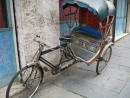
Pedestrians make communities come alive, as they did for us in the small, medieval walled Italian city of Lucca in Tuscany, where it took only 20 minutes to walk from the east gate to the west gate. Or In Roma, where gas-powered vehicles and people constantly overlap. Walking on any sidewalk in Roma, for example, you can expect to encounter any or all of the following: a grandparent walking with a cane or a grandchild, kids kicking a soccer ball, a mother riding a bicycle with her child on it, a teenager on a scooter, a young adult riding a motorcycle or a small car, parked.

Here in the DSA, where traffic rules make everyone paranoid to do what is done naturally in the EU, brains and blood would be splattered everywhere because people’s heads could not take the tension that comes with the free flow of people and machines as is customary there. The few driving rules religiously obeyed in the EU are adequate to keep man and machine moving along while the book of driving rules here, which are actively enforced by local law enforcement officials who are constantly cruising roadways like sharks in the ocean hunting for their next meal, seem artificial in their guarantee of safety.
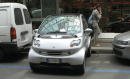
In the DSA, police and police cruises are always on the hunt. While driving in the EU, in its cities and on its Autostradas, I can remember seeing only a dozen or so police. These public officials, looking sharp in the military-style uniforms [a la CHIPS] were either standing with their buddies in traffic circles or were watching the ebb and flow of cars and people with a benevolent attitude of “let the flow go,” or as we might say here, ”no harm, no foul.”

In Italy, all cars are equipped with the same turn signals as cars in the DSA. But Italian drivers rarely use them, preferring instead to go where they want when they want. From my first visit to Italy and Rome in 1999, I learned how cars and civilians coexist and witnessed interactions between the two that were veritable miracles of movement that to me approached walking on water or parting colorful seas.

Walking in Italian urban areas in Centro areas, where history has molded the urban landscape into either narrow channels of brick or stucco or into piazzas so large and august that statues and spouting fountains are the perfect compliment to walkers, I saw first hand and participated myself in the delicate if not fast-paced interplay of man and machine where no one stops for anyone but everyone makes way for the next guy.

Standing on a street corner in Roma, I once watched as two Italian business men, dressed as if they were Marcello Mastroianni in a Fellini movie, stepped from the relative safety of an Italian sidewalk into the streaming traffic speeding around one of the many roundabouts in the city. Without a hint of care for or acknowledgement of the oncoming traffic, the two men, looking at each other as they conversed with language and gesture, strode across the stream of cars, motorcycles, busses, and bicyclists as if they were protected by some special shied of invulnerability. Once on the opposite bank of the traffic stream, they kept walking, not once admitting through gesture any trepidation of the feat they had just performed.

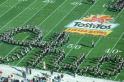
In Columbus, Ohio, where The Ohio State University marching band performs its signature act of uncoiling itself from a tight-knit square into a single stream of musicians who spell out in cursive the state name, the popular performance of Script Ohio is a hometown example of what is done in the EU everyday on a massive scale. The brass band musicians, when they hand write the name of their state, cross through each other at several points of intersection where letters are linked. In style befitting crossing a busy Italian street, the strutting marchers, playing their instruments as they march, never stop but speed up or slow down a micro-second so as not to hit an oncoming musician who was further back in the pack.

On Italian streets, where La Dulce Vita or "the sweet life" is made exciting by at the same time disdaining the powers of opposites while also calculating them, is a rare art that may never be understood or practiced in the DSA. Here, where our biggest public places are often times car parking lots, the exhilaration of walking in fast moving traffic is curtailed by personal paranoia and by an in-bred fear of violating traffic rules. If more people in the DSA walked more, the landscape, which is designed for and ruled by cars, would change to put people at the pinnacle of power, and relegate cars to what they are in the EU, the last choice in transportation.

In a timely report about how more and more aging Americans are being stranded at home because they cannot drive and must therefore rely upon the kindness of family and neighbors and the clear inadequacies of local bus companies, The Columbus Dispatch reports that about "82 percent of Americans 65 and older say they worry that they will be stranded when they no longer can drive, according to a survey last year by the American Public Transportation Association."

In 2005, the paper wrote, "there were 36.8 million people age 65 and older in the country, according to U.S. Census estimates," and "The number is expected to reach 72 million by 2030, representing about 20 percent of the population. The 85-and-older group is the fastest-growing segment of the population." A local AARP [American Association of Retired People] spokesperson addressed the obvious question that will only be exacerbated as more of our aging citizens become more isolated in their homes. Her poignant query of how these people are going to get around is a concern we should all focus on here. The EU, for many reasons, has not forsaken its intermodal public transportation systems and while it takes a bit of work, people of all ages there can live their lives without a car. Is it too late to improve our pubic transportation systems here? The simple answer is no, but the complex answer is that for change to happen here, Americans need to change their attitude about the importance of public transportation and elect public officials who have the political will to invest in system improvements going forward. Otherwise, people, especially seniors, will find life more frustrating as their transportation options dwindle, leading them unavoidably to becoming increasingly marooned in their homes and separated from the world around them.

As local bus systems like the Central Ohio Transportation Authority (COTA) try valiently but vainly to compete against the power of the car, it is little wonder that meager systems like COTA, which is not only financially imploding on itself and but finally if not unfortunately giving up the ghost on years of preparatory work to bring light rail to the area, will never be able to lure enough passengers from the driver's seat of a revving, engineered sanctum world to a passenger seat on a public system that is not comfortable or private and does not contribute to their self-esteem. The lastest Hummer car commercial makes my point, as it implies will happen if you lay down $50,000 and buy a behemoth that only produces 13-miles per gallon. Filling the 32-gallon gas tank of the car brought to American roads in the early 90s through the action-hero proclamations of Arnold Schwarzenegger only costs about $96 a pop at today's $3-gas prices. A small price to pay, surely, to feel like a man, even if you are a soccer mom.